
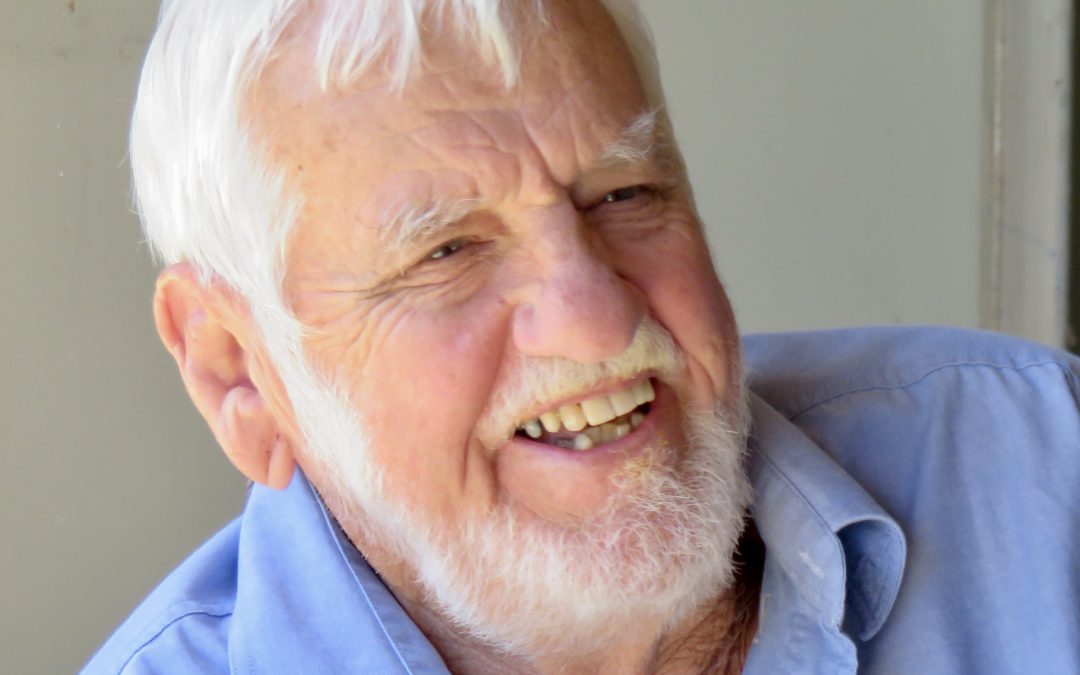
Some people spend a lifetime following accepted thinking.
Dr George Seifert spent his asking, “What if there’s a better way?”
It’s that curiosity, combined with a practical understanding of cattle, that helped shape one of Australia’s most important beef breeds, the Belmont Red.
George’s story begins in the Kalahari region of South Africa, where he grew up surrounded by cattle. It was here that he developed a lifelong passion for livestock, eventually studying Animal Science at the University of Pretoria under Professor Bonsma. Even his first university thesis reflected what would become a recurring theme throughout his career, comparative studies on the growth and development of Afrikaner and Hereford steers from birth to 24 months of age.
In 1960, George and his wife, Maria set off on what was supposed to be a two-year working holiday in Australia.
As George often jokes, “We’re still working and waiting for the holiday.”
After working in Victoria and teaching agriculture in Tasmania, an opportunity arose that would change not only his life, but the future of the Australian beef industry. He joined the National Cattle Breeding Station at Belmont, near Rockhampton, as one of the most junior staff members. He didn’t arrive expecting to become a leading scientist. His ambition at the time was simply to one day own a cattle property.
What made George different was that he never saw cattle as numbers on a spreadsheet.
While many researchers concentrated on laboratory science, George understood cattle from the paddock up. He believed that research only mattered if it made producers more profitable and their cattle more productive.
That practical philosophy became the foundation of everything he did.
Over the next 24 years with CSIRO, George led groundbreaking research into fertility, growth, parasite resistance, temperament and objective genetic selection. He pioneered work on cattle tick resistance, demonstrated the economic value of selecting for fertility, and developed practical breeding systems that producers could actually use. Many of the genetic evaluation techniques now considered standard in the Australian beef industry were first developed or refined using the Belmont cattle.
George was also one of the first scientists to challenge the industry’s reliance on chemicals for parasite control. Instead, he demonstrated that selecting naturally adapted cattle could dramatically reduce the need for chemical treatments while improving productivity at the same time. It was a philosophy well ahead of its time and one that remains highly relevant today.
His influence didn’t stop at Australia’s borders.
George became an internationally respected authority on tropical cattle breeding, advising governments, universities and livestock industries throughout Southeast Asia, South America and Africa. His work helped establish breeding programs, improve food security and open export opportunities for Australian cattle.
Despite an extraordinary career that included a PhD from Iowa State University, Principal Research Scientist with CSIRO, dozens of scientific publications, international consultancies and invitations to speak around the world, George has always remained, first and foremost, a cattleman.
Perhaps the greatest testament to his life’s work is that the Belmont Red continues to demonstrate the principles he championed decades ago: adaptation, fertility, objective selection and profitability under commercial conditions.
These weren’t just scientific theories.
They were practical solutions for real producers.
Through an interview series, we’re privileged to hear George tell the Belmont story in his own words—from the early days of the Belmont Research Station through to the development of one of Australia’s most successful tropically adapted beef breeds.
It’s a story worth telling.